

Port Pirie - Hamilton Ventilator(25)
Hamilton Ventilator Course
Mechanical ventilation: Basic principles, Ventilator modes/settings, Setting up the Hamilton Ventilator for Mechanical Ventilation
Course Accreditation
The course is an accredited learning activity for 6 hours for medical and nursing continuing professional development.
Latest Course update: January 2025
This course is suitable for Medical Officers, Nurses, Paramedics and Students
 Mechanical ventilation is one of the central skills in critical care medicine. In the emergency patient it is most often used to improve oxygenation and ventilation in the patient with acute respiratory failure, altered conscious state and to treat acute raised intracranial pressure. Ventilation may be required to treat life-threatening presentations of COPD, heart failure, pneumonia, sepsis, trauma, intracerebral haemorrhage and overdose. An understanding of the indications, complications, practical aspects of mechanical ventilation and respiratory failure is essential in emergency medicine.
The course explores the following topics:
1. Ventilation: Airway Management
2. Ventilator Mode and Settings
3. Ventilation: Application to Clinical Practice
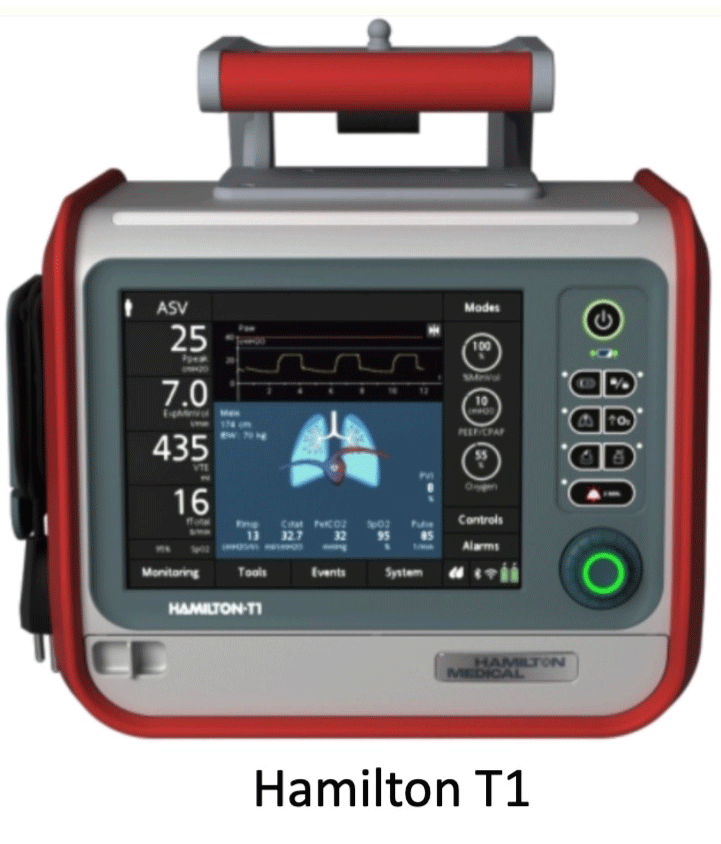
4. Setting up the Hamilton T1 Ventilator for Mechanical ventilation
Port Pirie - Analgesia and Procedural Sedation CPD Course (25)

Post Pirie: Acute Pain + Procedural Sedation
Core Principles, Pharmacology, Clinical Practice
Course Certification
The course is a certified learning activity for 12 hours continuing professional development: Acute Pain (6 hours CPD), Procedural Sedation (6 hours CPD).
A CPD certificate may be downloaded individually for Acute Pain and Procedural Sedation.
Welcome to the Course
Latest Course Update: February 2025
Acute Pain Course Outline :
-
Module 1. Clinical approach to acute pain : Basic principles
-
Module 2. Clinical Pharmacology of Oral analgesics
-
Module 3. Pharmacological approaches for Managing Severe pain
Procedural Sedation Course Outline :
-
Module 1. Parenteral Procedural Sedation : Core Principles
-
Module 2. Intravenous Sedation using Midazolam / Fentanyl
-
Module 3. Intravenous Sedation using Propofol
-
Module 4. Parenteral Sedation using Ketamine
-
Module 5. Intranasal Sedation using Midazolam, Fentanyl, Ketamine
Noninvasive Ventilation and HFNP Oxygen (Port Pirie)

HFNP Oxygen and Noninvasive Ventilation in Clinical Care
Humidified High Flow Nasal Prong Oxygen and Non-Invasive Ventilation (CPAP/BiPAP)
Course Accreditation
The course is an accredited learning activity for 6.5 hours for medical and nursing continuing professional development.
Latest Course update: November 2024
Designed for medical officers, nurses, paramedics and students in all medical fields.
Ventilation plays an increasing role in the management of seriously ill patients in the emergency department. Traditionally, ventilation has been limited to the delivery of positive pressure ventilation in the unconscious, intubated (often paralysed) patient. This is generally referred to as "assisted" or "mechanical" ventilation. In recent years, the use of noninvasive ventilation has become widespread due to research that has demonstrated the benefit of CPAP and BiPAP in patients with chronic obstructive pulmonary disease (COPD) and acute pulmonary oedema, two of the most common causes for life-threatening presentations due to acute respiratory distress to the emergency department.
Another method of Noninvasive respiratory support, Humidified High Flow Nasal prong Oxygen (HFNP) is being increasingly used in the management of adults with severe respiratory distress and hypoxia. With a primary role as a bridge between low flow oxygen therapy (e.g., nasal specs at 2 l/min) and CPAP it may be often considered in patients with hypoxia receiving high flow oxygen mask therapy and in patients with severe respiratory distress requiring non-invasive ventilation. In this topic we will explore the evolving role of HFNP oxygen in clinical practice and distinguish which patients may be suitable for HFNP therapy and those in whom BIPAP should be used.
The course explores the following topics:
1. Humidified High Flow Nasal Prong Oxygen in Clinical Practice
2. Noninvasive Ventilation: Basic principles
3. Using CPAP in Acute Pulmonary Oedema
4. Using BiPAP in Chronic Obstructive Pulmonary Disease
Optional Module: Setting up the Oxylog ventilator for Noninvasive Ventilation
Basic Life Support 2020
Basic Life Support Prelearning
The BLS Course is a combined online/skills workshop program developed by LearnEM to provide training in the Australian Resuscitation Council (ARC) guidelines for Basic Cardiopulmonary Resuscitation (CPR) and Immediate management of Foreign Body Airway Obstruction.
The Basic Life Support course covers the core knowledge required for :
1. Recognising Cardiac Arrest
2. Initiating Basic CPR in adults and children
3. Use of the Automatic External Defibrillator (AED)
4. Recognising the symptoms of Airway Obstruction
5. Immediate management of Airway Foreign Body
6. Procedure for Basic CPR in the unconscious patient with Airway Foreign Body
Access is restricted to those registered for the Basic CPR Workshop
Introduction to Vascular Access Ultrasound (2023- 24)
Introduction to Vascular Access Ultrasound
Port Pirie - Analgesia and Procedural Sedation CPD Course (24)
Port Pirie : Analgesia and Procedural Sedation
Although the relief of acute pain is the most common reason that patients seek emergency care research studies have documented that acute pain is frequently poorly managed. There is often a complete failure to provide any form of analgesia in a timely manner and even when analgesia is provided it is often ineffective due to either poor drug selection, inappropriate route of administration or inadequate dosing. This phenomenon is so significant that it has been given its own name – “Oligoanalgesia”. In the first topic we explore the principles for assessing and treating acute pain and discover the rewards that result from a thoughtful and informed approach to providing pain relief.
In the second topic we examine the topic of "Procedural Sedation". This describes the administration of drugs in a controlled setting to reduce pain and / or awareness. Procedural sedation is used to reduce the pain associated with laceration repair and removal of foreign bodies from the ear or nose in the young child, the reduction and immobilisation of fractures and dislocations and emergency cardioversion of cardiac arrhythmias. The sedative agents most commonly used in procedural sedation are Midazolam +/- Fentanyl, Propofol and Ketamine. This course examines the indications, contraindications for procedural sedation, assessment, monitoring and after care of the patient undergoing procedural sedation and the common drugs used for procedural sedation.
Course Outline
Part 1 : Acute Pain Management
-
1. Core Principles
-
2. Oral analgesics
-
3. Severe pain
Part 2 : Procedural Sedation
-
4. Core Principles
-
5. Midazolam + Fentanyl, Propofol, Ketamine
If you have any problems or require more information: Contact LearnEM Support
Prelearning: Flinders Fertility Bedside Ultrasound 2024

Flinders Fertility : Ultrasound Prelearning
Core Principles, Knobology, Ultrasound of the Pelvis
Flinders Fertility : Bedside Emergency Ultrasound
Physics, Knobology, Pregnancy
Latest Update: january 2024
Access to the prelearning is restricted to participants enrolled in the U/S workshop
The prelearning modules introduces the core principles and knowledge required for the use of ultrasound in emergency practice and explores the application of ultrasound to imaging the pelvis in the First Trimester.
Nb. Access to the prelearning is restricted to participants enrolled in the U/S workshop
Flinders NP : Bedside Ultrasound Fundamentals
The following modules introduce the core principles and knowledge required for the use of ultrasound in emergency practice.
The first topic introduces the physics behind ultrasound and the second explores the topic of knobology. Although the content is perhaps a little dry these modules provide the foundation to understanding how to use and interpret ultrasound in clinical practice. The remaining topic explores the application of ultrasound to assist IV Cannulation.
Course outline:
1. Principles of diagnostic ultrasound imaging
2. Practical use of the ultrasound machine
3. Ultrasound guided procedures
Instructions: Course Enrolment
Use the "Send via PayPal" button below to pay by Credit Card (or using a PayPal account)
-
Course Fee: $45.00 (AUD) + $4.50 (GST) = $49.50
-
Duration of enrolment is 12 months from date of payment
|
|
Secure Online Payments using Credit Card You may pay using your Credit Card or via a Paypal account. All payments are processed through the Paypal Gateway to provide maximum security to credit card payments. |

Refund Policy: We guarantee the quality of our online courses, however, if the course does not meet your expectations you may receive a refund within 14 days of enrolling in the course providing you have not viewed or submitted any of the course quizzes. The pre-course quiz is exempted as this is completed before you can view the course.
If you have any problems or require more information: Contact LearnEM Support
Prelearning - Flinders RHSA ACLS 2018
Flinders Rural Health SA
Prelearning : Advanced Cardiac Life Support
Latest Course update : January 2018
Management of cardiac arrest is a critical skill for all health professionals. Regular updates are essential for maintaining the knowledge and practical skills required for CPR. In the following modules we draw upon the most recent Australian Resuscitation Council recommendations to review the approach to the patient with suspected cardiac arrest. For each topic an eTutorial is used to introduce the topic and provides a useful background to work through the clinical case scenario.
The prelearning covers :
-
1. Diagnosis of cardiac arrest
-
2. Procedure and algorithm for basic life support
-
3. Cardiac arrest rhythms
-
4. Algorithm for advanced life support
-
5. Procedure for defibrillation
-
6. Post resuscitation care
-
7. Managing the patient with foreign body airway obstruction
-
8. Paediatric cardiopulmonary resuscitation
If you have any problems or require more information : Contact LearnEM Support
Prelearning - Flinders RHSA ACLS 2024
Flinders Rural Health SA
Prelearning : Advanced Cardiac Life Support
Welcome to the Course
Latest Course Update: January 2024
The course is an accredited learning activity for medical and nursing continuing professional development.
Management of cardiac arrest is a critical skill for all health professionals. In the following modules, we draw upon the most recent Australian Resuscitation Council (ARC) and Australian and New Zealand Committee of Resuscitation (ANZCOR) recommendations for managing the patient with suspected cardiac arrest.
The course explores the following topics:
1. Diagnosis of cardiac arrest
2. Procedure and algorithm for basic life support
3. Cardiac arrest rhythms
4. Algorithm for advanced life support
5. Procedure for defibrillation
6. Post resuscitation care
7. Managing the patient with foreign body airway obstruction
8. Paediatric cardiopulmonary resuscitation
Intensive Care Paramedic Course
Pre-learning for the Intensive Care (EC) Paramedic Course
This course provides pre-learning and learning resources for workshop presented by Dr Peter Stuart at the Intensive Care Paramedic Course 2013. The learning resources (readings and exercises) and additional eLearning are available to those who attended the workshop. An enrolment key is required to access these resources.
Basic Life Support 2025

Basic Life Support Prelearning (2025)
Basic Life Support, Foreign Body Airway Obstruction
Basic Life Support Prelearning 2025
Latest Update: January 2025
The BLS Course is a combined online/skills workshop program developed by LearnEM to provide training in the Australian Resuscitation Council (ARC) guidelines for Basic Cardiopulmonary Resuscitation (CPR) and Immediate management of Foreign Body Airway Obstruction.
The Basic Life Support course covers the core knowledge required for :
1. Recognising Cardiac Arrest
2. Initiating Basic CPR in adults and children
3. Use of the Automatic External Defibrillator (AED)
4. Recognising the symptoms of Airway Obstruction
5. Immediate management of Airway Foreign Body
6. Procedure for Basic CPR in the unconscious patient with Airway Foreign Body
Access is restricted to those registered for the Basic CPR Workshop
SA Rural - ALS Prelearning 2025

SA Rural - ALS Prelearning 2025
Cardiopulmonary Resuscitation and Immediate Care of the Critically Ill
Latest Update: January 2025
Welcome to the 2025 version of the prelearning for the SA Rural - ALS training.
In the prelearning we explore not only the patient in cardiac arrest requiring Cardiopulmonary Resuscitation but focus in addition on the patient at risk for deteriorating into cardiac arrest. It is the goal of this online course to build your confidence and skills to assess and commence management of the seriously ill patient and to provide advanced life support irrespective of whether the patient presents to A&E or deteriorates on the ward.
Please note access to these courses is restricted to those registered for SA Regional LHNs - ALS Training
A Little Reminder - Be Polite !
LearnEM provides this course free to SA Health. This aligns with LearnEM's goal of supporting and providing high quality education and training to nurses and medical officers working in rural environments. We acknowledge workforce pressures but remind individuals to behave respectfully toward LearnEM staff. Aggressive behaviour will not be tolerated and will be reported to RSS Nursing Director.
To enrol in the Regional LHNs (SA) - ALS Prelearning
-
Ensure you are logged in to LearnEM
-
Click on the course from the list below
- Click on the "Enrol in this course" icon at the bottom of the course front page.
Nb. You will need an enrolment key - you can find this on the SA Health iLearn website (under instructions for the ALS training). The enrolment key is identical to the one used for previous courses.
If you have any problems or require more information : Contact LearnEM Support
Basic Life Support 2024

Basic Life Support Prelearning (2024)
Basic Life Support, Foreign Body Airway Obstruction
Basic Life Support Prelearning 2024
Latest Update: January 2024
The BLS Course is a combined online/skills workshop program developed by LearnEM to provide training in the Australian Resuscitation Council (ARC) guidelines for Basic Cardiopulmonary Resuscitation (CPR) and Immediate management of Foreign Body Airway Obstruction.
The Basic Life Support course covers the core knowledge required for :
1. Recognising Cardiac Arrest
2. Initiating Basic CPR in adults and children
3. Use of the Automatic External Defibrillator (AED)
4. Recognising the symptoms of Airway Obstruction
5. Immediate management of Airway Foreign Body
6. Procedure for Basic CPR in the unconscious patient with Airway Foreign Body
Access is restricted to those registered for the Basic CPR Workshop
SA Rural - ALS Prelearning 2024

Regional LHNs (SA) - ALS Pre-learning
Advanced Life Support, Resuscitation of the Seriously Ill, Acute Myocardial Ischaemia
The ALS Course is a combined online/skills workshop program developed by LearnEM to provide nurses with a broad understanding of the Australian Resuscitation Council (ARC) guidelines for
-
Basic and Advanced Cardiopulmonary Resuscitation
-
Immediate assessment and Resuscitation of the Critically Ill / Deteriorating Patient
-
Emergency assessment / management of Acute Myocardial Ischaemia
The ALS course is a blended program. This means that some of the learning is done online (eLearning) and some undertaken face-to-face in a workshop setting.
Please note access to these courses is restricted to those registered for SA Regional LHNs - ALS Training
To enrol in the Regional LHNs (SA) - ALS Prelearning
-
Ensure you are logged in to LearnEM
-
Click on the course from the list below
- Click on the "Enrol in this course" icon at the bottom of the course front page.
Nb. You will need an enrolment key - you can find this on the SA Health Moodle website (under instructions for the ALS training). The enrolment key is identical to the one used for previous courses.
If you have any problems or require more information : Contact LearnEM Support
RESP25 Obstetrics Prelearning

RESP Obstetrics : Prelearning
Obstetric and Neonatal Emergencies, Obstetric Ultrasound, Human Factors in Resuscitation
Latest Course update : January 2025
The RESP-Obstetrics course has been developed to review the presentation and management of obstetric and neonatal emergencies and provide opportunities for enhancing skills in the use of bedside ultrasound in obstetric practice. The pre-learning sets the scene for the skills and simulation workshop and explores obstetric complications in late pregnancy and the postnatal period, first trimester ultrasound, neonatal emergencies including newborn CPR and neonatal resuscitation and provides an introduction to the topic of human factors in resuscitation.
Pre-learning Outline:
1. Pre-Eclampsia
2. Antepartum Haemorrhage and PPROM
3. Postpartum Haemorrhage
4. First Trimester Ultrasound
5. Sick Neonate
6. Newborn Resuscitation
7. Human Factors in Resuscitation
RESP25 Paediatrics Prelearning

RESP Paediatrics - Prelearning
Assessment and Treatment of the Child with Life-Threatening Illness
RESP Paediatrics - Prelearning
Latest Course update: January 2025
Managing the seriously ill child can be one of the most frightening and distressing experiences for the clinician. There are many challenges to assessing and treating the child presenting with serious illness, including recognising the early signs of serious illness, lack of a detailed history and examination, issues relating to patient cooperation, procedural difficulties (eg. obtaining IV access), and physiological challenges (eg. masking of signs of severe illness and risk for rapid deterioration). In this course, we explore the immediate assessment and treatment of the seriously ill child, and examine the clinical presentation and acute management of life-threatening diseases in children.
The prelearning explores the following topics:
1. Paediatric Basic and Advanced Life Support
2. Red Flags for Serious Illness
3. Approach to the Seriously Ill Child
4. Airway: Acute Anaphylaxis
5. Breathing: Acute Respiratory Distress and Life Threatening Asthma
6. Circulation: Paediatric Vomiting and Dehydration
7. Disability: The Fitting Child
8. Exposure: The Febrile Neonate
9. Newborn Advanced Life Support
RESP25 Anaesthesia Prelearning

RESP Anaesthesia : Prelearning
Emergency Response Activities, Procedural Sedation, Human Factors in Resuscitation
Course Accreditation
The course is an accredited learning activity for continuing professional development. For GPs the course is an accredited CPD activity for the 2023-2025 triennium with ACRRM (Course Code : 29959) and RACGP (Course Code : 435628: 10.5 Educational Activity and 13.5 Reviewing Performance Hours).
Welcome to the Course
Latest Course Update: April 2024
The RESP-Anaesthetics course has been developed to provide CPD accredited training in the management of three anaesthetic emergencies : Perioperative Anaphylaxis, Can't Intubate, Can't Oxygenate and Cardiac Arrest. The workshop will in addition explore the procedural sedation in the emergency patient, ultrasound guided fascia iliaca block, approach to airway management and ventilation in the critically ill (hypotensive +/- hypoxic) patient and the role of human factors in resuscitation.
Pre-learning Outline:
1. Emergency Response Activity (1) : Perioperative Anaphylaxis
2. Emergency Response Activity (2) : Can't Intubate, Can't Oxygenate
3. Emergency Response Activity (3) : Basic and Advanced CPR
4. Procedural Sedation in the Emergency Patient
5. Human Factors in Resuscitation
The online learning aims to introduce core knowledge for the workshop and provide resources for future learning.
RESP25 Critical Care Prelearning

RESP - Critical Care
BLS/ALS, Critically Ill / Injured Patient, Emergency Airway / Ventilation, Seriously Ill Child
RESP Critical Care eLearning (2025)
The course is an accredited learning activity for medical continuing professional development. The course is an accredited CPD activity for : 2023-2025 triennium. RACGP (13.5 Educational Activity & 18 Reviewing Performance Points) and ACRRM (Points to be advised).
Latest Course Update: January 2025
The RESP workshop was developed by a team of emergency physicians, rural GPs, and nurse and paramedic educators.
The program provides 24 hours of training incorporating online (eLearning) and a 2 day practical skills workshop. Topics include: Resuscitation of the Critically Ill/Injured Patient, Cardiopulmonary Resuscitation, Basic and Advanced Airway Management, Ventilation using an Oxylog Ventilator, Resuscitation Team Leadership and Teamwork, Difficult Vascular Access, Cervical Spine Management in Trauma, Chest Tube Insertion, Needle Aspiration, Cardiac Pacing/Cardioversion, and Newborn Resuscitation.
The workshop pre- and post-learning is delivered online and comprises 10 modules covering the topics:
-
Basic Life Support (BLS)
-
Advanced Cardiac Life Support (ALS)
-
Approach to the Critically Ill Patient
-
Recognising and Managing the Obstructed Airway
-
Mechanical Ventilation: Use of the Oxylog Ventilator
-
Managing the Patient with Acute Respiratory Compromise/Ventilation
-
Non-Invasive Ventilation in Acute Care
-
Assessment and Management of Circulatory Shock
-
Assessing and Treating the Critically Ill Child/Newborn Resuscitation
-
Immediate Management of the Patient with Major Trauma
Please note: Access to the online course is restricted to participants registered for the RESP Workshop
Information about the course
-
Designed for ED medical and nursing staff, Rural Medical Practitioners and Training Medical Officers
-
CME hours: Certified for 24 hours of continuing medical education
-
CPD accreditation: RACGP, ACRRM
-
Procedural Grant: Meets requirements for the Procedural Grant in Emergency Medicine and Anaesthesia
-
CPD Certificate is provided with successful completion of the course
Course Accreditation
The course is an accredited learning activity for medical continuing professional development. The course is an accredited CPD activity for : 2023-2025 triennium. RACGP (13.5 Educational Activity & 18 Reviewing Performance Points) and ACRRM (Points to be advised).
RESP24 Critical Care Prelearning

RESP - Critical Care
BLS/ALS, Critically Ill / Injured Patient, Emergency Airway / Ventilation, Seriously Ill Child
RESP Critical Care eLearning (2024)
The course is an accredited learning activity for medical continuing professional development. The course is an accredited CPD activity for : 2023-2025 triennium. RACGP (13.5 Educational Activity & 18 Reviewing Performance Points) and ACRRM (Points to be advised).
Latest Course Update: January 2024
The RESP workshop was developed by a team of emergency physicians, rural GPs, and nurse and paramedic educators.
The program provides 24 hours of training incorporating online (eLearning) and a 2 day practical skills workshop. Topics include: Resuscitation of the Critically Ill/Injured Patient, Cardiopulmonary Resuscitation, Basic and Advanced Airway Management, Ventilation using an Oxylog Ventilator, Resuscitation Team Leadership and Teamwork, Difficult Vascular Access, Cervical Spine Management in Trauma, Chest Tube Insertion, Needle Aspiration, Cardiac Pacing/Cardioversion, and Newborn Resuscitation.
The workshop pre- and post-learning is delivered online and comprises 10 modules covering the topics:
-
Basic Life Support (BLS)
-
Advanced Cardiac Life Support (ALS)
-
Approach to the Critically Ill Patient
-
Recognising and Managing the Obstructed Airway
-
Mechanical Ventilation: Use of the Oxylog Ventilator
-
Managing the Patient with Acute Respiratory Compromise/Ventilation
-
Non-Invasive Ventilation in Acute Care
-
Assessment and Management of Circulatory Shock
-
Assessing and Treating the Critically Ill Child/Newborn Resuscitation
-
Immediate Management of the Patient with Major Trauma
Please note: Access to the online course is restricted to participants registered for the RESP Workshop
Information about the course
-
Designed for ED medical and nursing staff, Rural Medical Practitioners and Training Medical Officers
-
CME hours: Certified for 24 hours of continuing medical education
-
CPD accreditation: RACGP, ACRRM
-
Procedural Grant: Meets requirements for the Procedural Grant in Emergency Medicine and Anaesthesia
-
CPD Certificate is provided with successful completion of the course
Course Accreditation
The course is an accredited learning activity for medical continuing professional development. The course is an accredited CPD activity for : 2023-2025 triennium. RACGP (13.5 Educational Activity & 18 Reviewing Performance Points) and ACRRM (Points to be advised).
RESP24 Paediatrics Prelearning

RESP Paediatrics - Prelearning
Assessment and Treatment of the Child with Life-Threatening Illness
RESP Paediatrics - Prelearning
Latest Course update: January 2024
Managing the seriously ill child can be one of the most frightening and distressing experiences for the clinician. There are many challenges to assessing and treating the child presenting with serious illness, including recognising the early signs of serious illness, lack of a detailed history and examination, issues relating to patient cooperation, procedural difficulties (eg. obtaining IV access), and physiological challenges (eg. masking of signs of severe illness and risk for rapid deterioration). In this course, we explore the immediate assessment and treatment of the seriously ill child, and examine the clinical presentation and acute management of life-threatening diseases in children.
The prelearning explores the following topics:
1. Paediatric Basic and Advanced Life Support
2. Red Flags for Serious Illness
3. Approach to the Seriously Ill Child
4. Airway: Acute Anaphylaxis
5. Breathing: Acute Respiratory Distress and Life Threatening Asthma
6. Circulation: Paediatric Vomiting and Dehydration
7. Disability: The Fitting Child
8. Exposure: The Febrile Neonate
9. Newborn Advanced Life Support
RESP24 Obstetrics Prelearning

RESP Obstetrics : Prelearning
Obstetric and Neonatal Emergencies, Obstetric Ultrasound, Human Factors in Resuscitation
Latest Course update : April 2024
The RESP-Obstetrics course has been developed to review the presentation and management of obstetric and neonatal emergencies and provide opportunities for enhancing skills in the use of bedside ultrasound in obstetric practice. The pre-learning sets the scene for the skills and simulation workshop and explores obstetric complications in late pregnancy and the postnatal period, first trimester ultrasound, neonatal emergencies including newborn CPR and neonatal resuscitation and provides an introduction to the topic of human factors in resuscitation.
Pre-learning Outline:
1. Pre-Eclampsia
2. Antepartum Haemorrhage and PPROM
3. Postpartum Haemorrhage
4. First Trimester Ultrasound
5. Sick Neonate
6. Newborn Resuscitation
7. Human Factors in Resuscitation
RESP24 Anaesthesia Prelearning

RESP Anaesthesia : Prelearning
Emergency Response Activities, Procedural Sedation, Human Factors in Resuscitation
Course Accreditation
The course is an accredited learning activity for continuing professional development. For GPs the course is an accredited CPD activity for the 2023-2025 triennium with ACRRM (Course Code : 29959) and RACGP (Course Code : 435628: 10.5 Educational Activity and 13.5 Reviewing Performance Hours).
Welcome to the Course
Latest Course Update: April 2024
The RESP-Anaesthetics course has been developed to provide CPD accredited training in the management of three anaesthetic emergencies : Perioperative Anaphylaxis, Can't Intubate, Can't Oxygenate and Cardiac Arrest. The workshop will in addition explore the procedural sedation in the emergency patient, ultrasound guided fascia iliaca block, approach to airway management and ventilation in the critically ill (hypotensive +/- hypoxic) patient and the role of human factors in resuscitation.
Pre-learning Outline:
1. Emergency Response Activity (1) : Perioperative Anaphylaxis
2. Emergency Response Activity (2) : Can't Intubate, Can't Oxygenate
3. Emergency Response Activity (3) : Basic and Advanced CPR
4. Procedural Sedation in the Emergency Patient
5. Human Factors in Resuscitation
The online learning aims to introduce core knowledge for the workshop and provide resources for future learning.
RDWA GP Inservice Prelearning 2024

RDWA GP Inservice Workshop
Basic and Advanced Life Support, Assessment and Resuscitation of the Critically Ill Patient
Course Accreditation
The course is an accredited learning activity for medical continuing professional development. The course is an accredited CPD activity for : 2023-2025 triennium. RACGP (9 Educational Activity & 8.5 Reviewing Performance Points) and ACRRM (Points to be advised).
Welcome to the Course
Latest Course Update: January 2024
The RDWA GP Inservice Workshop is delivered using a combination of online learning of core material with a hand's on skills / simulation workshop. It is the goal of this online course to review basic and advanced life support and the principles for the assessment and commence management of the seriously ill patient.
Topics covered in the course include include:
-
Basic and Advanced Life Support
-
Assessment and Resuscitation of the Critically Ill Patient
-
Basic Airway Management
-
Acute Respiratory Distress and Non-invasive Ventilation
-
Circulatory Shock and Sepsis
-
Cardiac Arrhythmias: ECG Diagnosis, Cardiac Pacing, Cardioversion
Please note access is restricted to those registered for RDWA Locum ALS2 Workshop
RDWA Ultrasound (Part 2)
RDWA Primary Care Ultrasound (Part 2)
Bones/Soft Tissues, US Guided Procedures Trauma
Access to the prelearning is restricted to participants enrolled in the U/S workshop
The Primary Care Ultrasound course is delivered using a combination of online learning of core material with a hands-on skills/simulation workshop. This second part of the online course introduces you to imaging of the musculoskeletal system and lung using ultrasound, the FAST (Focused assessment in trauma) protocol and ultrasound guided procedures.
The following topics may be completed after the workshop
-
Lung Ultrasound
-
Musculoskeletal / Soft Tissue Ultrasound
-
US Guided Procedures
-
Trauma (eFAST examination)
Nb. Access to the prelearning is restricted to participants enrolled in the U/S workshop
RDWA Ultrasound (Part 1)
RDWA Primary Care Ultrasound (Part 1)
Basic Principles, Knobology, Abdominal Aorta, First Trimester Ultrasound
Access to the prelearning is restricted to participants enrolled in the U/S workshop
The Primary Care Ultrasound course is delivered using a combination of online learning of core material with a hands-on skills/simulation workshop. The first part of the online course covers set up of the machine and optimising images, selection and placement of probes, ultrasound of the abdomen (including aorta, ascites, trauma), pelvis (including bladder and first trimester pregnancy).
The following prelearning modules introduce the core principles and knowledge required for the use of ultrasound in emergency practice and explore the application of ultrasound to the setting of primary care.
Primary Care Ultrasound (Part 2)
The second part of the Online learning for the Primary Care Ultrasound course may be completed before or after the workshop. The course explores imaging of the musculoskeletal system and lung using ultrasound, the FAST (Focused assessment in trauma) protocol and ultrasound guided procedures. Click here to view Primary Care Ultrasound (Part 2) course.
Prelearning: B-CET Point of Care Ultrasound (2025)

Prelearning: B-CET Point of Care Ultrasound
Knobology, Aorta, FAST/eFAST, DVT, Lung, Procedures
Point of Care Ultrasound
Latest Update: January 2025
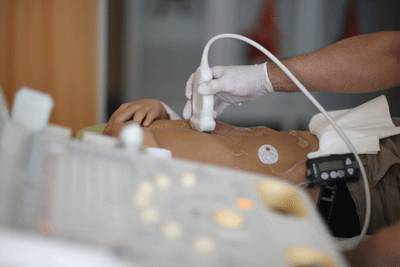 The prelearning explores the core principles and knowledge required for the use of ultrasound in emergency practice and explore the application of ultrasound to clinical care for the identification of abdominal aortic aneurysm, intra-abdominal injury in the trauma patient and pneumothorax
The pre-learning is divided into the following 5 topics
-
Principles of Diagnostic Ultrasound Imaging
-
Practical use of the Ultrasound machine
-
Abdominal Aortic Aneurysm
-
Trauma (FAST examination)
-
Lung Ultrasound
Access to the prelearning is restricted to participants enrolled in the B-CET Point of Care Ultrasound workshop
B-CET Ventilation Workshop Prelearning (25)

B-CET Respiratory / Ventilation Workshop
Barossa Hills Fleurieu Collaboration for Education and Training
Welcome to the Prelearning
Latest Course Update: January 2025
Ventilation plays an increasing role in the management of seriously ill patients in the emergency department. Traditionally, ventilation has been limited to the delivery of positive pressure ventilation in the unconscious, intubated (often paralysed) patient. This is generally referred to as "assisted" or "mechanical" ventilation. In recent years, the use of noninvasive ventilation has become widespread due to research that has demonstrated the benefit of CPAP and BiPAP in patients with chronic obstructive pulmonary disease (COPD) and acute pulmonary oedema, two of the most common causes for life-threatening presentations due to acute respiratory distress to the emergency department.
Another method of Noninvasive respiratory support, Humidified High Flow Nasal prong Oxygen (HFNP) is being increasingly used in the management of adults with severe respiratory distress and hypoxia. With a primary role as a bridge between low flow oxygen therapy (e.g., nasal specs at 2 l/min) and CPAP it may be often considered in patients with hypoxia receiving high flow oxygen mask therapy and in patients with severe respiratory distress requiring non-invasive ventilation. In the prelearning we explore the evolving role of HFNP oxygen in clinical practice and identify patients who may be suitable for HFNP therapy.