

Facilitator Certificate

Facilitator Certificate: Clinical Education and Training
Structured Online Learning in Preparation for the Workshop
About the Course
The course has been developed to provide a foundation to the delivery of clinical education and training.
The course explores The Educator/Facilitator role, Program Development, Leading Interactive Small Group Discussions, Teaching Procedural Skills, Immersive Simulation Training, Assessment, Competency and Evaluation and Challenges to Clinical Education.
The Course has three components:
-
Course Work undertaken over 12 weeks
-
Face to Face training delivered over two days and
-
Work Based Assessments.
Certification will require satisfactory completion of all three components and satisfactory completion of the Work Based Assessments assessing competency in the areas of Procedural Skills Training, Clinical Simulation and Group Discussion.
Course Learning Outcomes
At the completion of the course the learner should be able to
-
Apply teaching behaviours and attitudes that incorporate adult learning principles and promote learner centred clinical teaching.
-
Prepare and deliver white board presentations that demonstrate structure, relevance and the engagement of learners.
-
Research, structure and teach procedural skills that considers the environment, time constraints, learners needs and background, equipment and assessment of learning.
-
Prepare and manage clinical simulation scenarios that are realistic, appropriate to the learner's level of skill/knowledge, take account of learner safety and recognise the critical role of debrief in maximising learning and reflection.
-
Become self-reflective educators that actively seek to continue to learn, develop their skills and draw on observer feedback to continually develop their teaching practice.
CRASH - Skills / Simulation Workshop
CRASH Workshop eLearning
Latest Course update : January 2019
The CRASH workshop was developed by a team of emergency physicians, rural GPs, nurse and paramedic educators.
The program provides 24 hours of training incorporating on line (e-learning) and a 2 day practical skills workshop. Topics include : Resuscitation of the critically ill / injured patient, Cardiopulmonary resuscitation, Basic and advanced airway management, Ventilation using an Oxylog Ventilator, Resuscitation team leadership and teamwork, Difficult vascular access, Cervical spine management in trauma, Chest tube insertion, Needle aspiration, Cardiac pacing / Cardioversion, Newborn resuscitation.
The Workshop Pre and Post learning is delivered On-line and comprises 10 modules covering the topics of
-
Basic Life Support (BLS)
-
Advanced Cardiac Life Support (ALS)
-
Approach to the Critically ill Patient
-
Recognising and Managing the Obstructed Airway
-
Mechanical Ventilation : Use of the Oxylog Ventilator
-
Managing the Patient with Acute Respiratory Compromise / Ventilation
-
Non-invasive Ventilation in Acute Care
-
Assessment and Management of Circulatory Shock
-
Assessing and Treating the Critically ill Child / Newborn Resuscitation
-
Immediate Management of the Patient with Major Trauma
Please note : Access to the On-line Course is restricted to Participants registered for the CRASH Workshop
Information about the Course
-
Designed for ED Medical and Nursing staff, Rural Medical Practitioners and Training Medical Officers
-
CME hours : Certified for 24 hours of continuing medical education
-
CPD accreditation : RACGP, ACRRM
-
Procedural Grant : Meets requirements for the Procedural Grant in Emergency Medicine and Anaesthesia
-
CPD Certificate is provided with successful completion of the course
Course Accreditation
The course is an accredited CME activity for
RACGPRACGP QA and CPD (40 Category 1 points) |
|
ACCRM10 ALS, 6 Extended Skills and 4 Core Points 16 Anaesthetic Extended 4 MOPS anaesthetic core points |
|

Introduction to Rural Anaesthesia

Introduction to Rural Anaesthesia
Online Learning Resources for Rural Practice
Rural Skills Program
The online training is delivered using web-based tutorials supported by procedural videos, selected readings and digital resources. The training is divided into 6 modules each providing 2 to 4 hours of teaching with completion of each module assessed using an online summative MCQ.
Course Structure
-
Anaesthetic Medications
-
Airway Management
-
Physiology, Preoperative Assessment
-
Checks, Observations, Rescue Medications, Paediatrics
-
Anaesthetic Complications
-
Neuroaxial and ED Anaesthesia
Introduction to Rural Emergency Medicine
Introduction to Rural Emergency Medicine
Rural Skills Program
The online training is delivered using web-based tutorials supported by procedural videos, selected readings and digital resources. The training is divided into 6 modules each providing 2 to 4 hours of teaching with completion of each module assessed using an online summative MCQ.
Course Structure
-
EM Core Concepts
-
Medical Emergencies
-
Surgical Emergencies
-
Mental Health Emergencies
-
Trauma
-
Paediatric Emergencies
Introduction to Rural Obstetrics

Introduction to Rural Obstetrics
Online Learning Resources for Rural Practice
Rural Skills Program
The online training is delivered using web-based tutorials supported by procedural videos, selected readings and digital resources. The training is divided into 6 modules each providing 2 to 4 hours of teaching with completion of each module assessed using an online summative MCQ.
Course Structure
-
Antenatal Care
-
Antenatal Complications
-
Labour and Delivery
-
Complicated Delivery
-
Newborn and Neonatal Care
-
Maternity Care in Indigenous Communities
Introduction to Rural Obstetrics (2023)
Introduction to Rural Obstetrics
Rural Skills Program
The online training is delivered using web-based tutorials supported by procedural videos, selected readings and digital resources. The training is divided into 6 modules each providing 2 to 4 hours of teaching with completion of each module assessed using an online summative MCQ.
Course Structure
-
Antenatal Care
-
Antenatal Complications
-
Labour and Delivery
-
Complicated Delivery
-
Newborn and Neonatal Care
-
Maternity Care in Indigenous Communities
Ultrasound Guided Vascular Access
Workshop Prelearning
Ultrasound Guided Vascular Access for Nurses
The following module introduce the procedure for Ultrasound Guided Vascular Access and will assist with your preparation for the workshop. An enrolment key for the course is available from the coordinator of your course.
If you have any problems or require more information: Contact LearnEM Support
ALS 1 Core Pre-learning
ALS 1 Core Pre-Learning
Please note: Access to the online course is restricted to participants registered for the ALS Core Workshop
Latest Course update: January 2019
The ALS Core workshop was developed by a team of emergency physicians, rural GPs, nurse and paramedic educators.
Management of cardiac arrest is a critical skill for all health professionals. Regular updates are essential for maintaining the knowledge and practical skills required for CPR. In the following modules we draw upon the most recent Australian Resuscitation Council recommendations to review the approach to the patient with suspected cardiac arrest. For each topic an eTutorial is used to introduce the topic and provides a useful background to work through the clinical case scenario.
The course covers:
1. Diagnosis of cardiac arrest
2. Procedure and algorithm for basic life support
3. Cardiac arrest rhythms
4. Algorithm for advanced life support
5. Procedure for defibrillation
6. Post resuscitation care
Please note: Access to the online course is restricted to participants registered for the ALS Core Workshop
Register for ALS Core Workshop
Prelearning - Flinders RHSA ACLS 2025
Flinders Rural Health SA
Prelearning : Advanced Cardiac Life Support
Welcome to the Course
Latest Course Update: January 2024
The course is an accredited learning activity for medical and nursing continuing professional development.
Management of cardiac arrest is a critical skill for all health professionals. In the following modules, we draw upon the most recent Australian Resuscitation Council (ARC) and Australian and New Zealand Committee of Resuscitation (ANZCOR) recommendations for managing the patient with suspected cardiac arrest.
The course explores the following topics:
1. Diagnosis of cardiac arrest
2. Procedure and algorithm for basic life support
3. Cardiac arrest rhythms
4. Algorithm for advanced life support
5. Procedure for defibrillation
6. Post resuscitation care
7. Managing the patient with foreign body airway obstruction
8. Paediatric cardiopulmonary resuscitation
ALS2 Prelearning 2025
ALS2 Masterclass Pre-Course eLearning
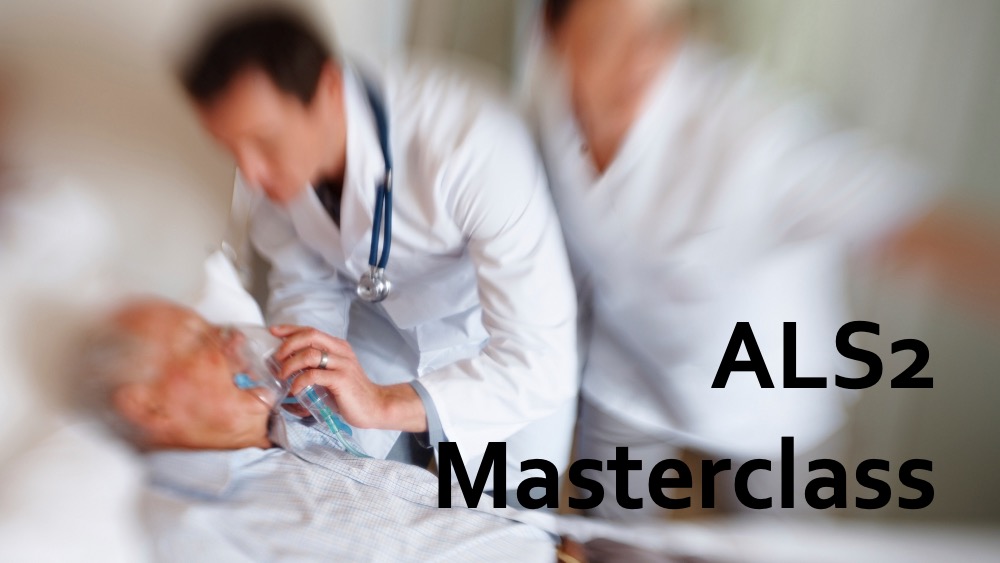 The ALS Masterclass course is designed for medical and nursing staff to be (re)accredited in the skills required for Basic and Advanced Life Support with a focus on extending the knowledge and skills in Resuscitation/Stabilisation of the critically Ill or arrested patient.
The course is delivered in a supportive learning environment and uses interactive online pre-learning to cover core knowledge skills and a one day workshop for procedural skills and simulation training.
The course is suited to health professionals who wish to extend their knowledge in management of the seriously ill or deteriorating patient in the emergency setting, met call, and rural and remote environment.
Topics covered in the course include include:
-
Basic and Advanced Life Support
-
CPR during Covid19 and in special circumstances
-
Assessment and Resuscitation of the Critically Ill Patient
-
Basic Airway Management
-
Acute Respiratory Distress and Non-invasive Ventilation
-
Circulatory Shock and Sepsis
-
Cardiac Arrhythmias: ECG Diagnosis, Cardiac Pacing, Cardioversion
The ALS Masterclass course is a blended program. This means that some of the learning is done online (eLearning) and some undertaken face to face in a workshop setting.
Please note access is restricted to those registered for ALS2 Masterclass
ALS2 Masterclass Prelearning 2024
ALS2 Masterclass Pre-Course eLearning
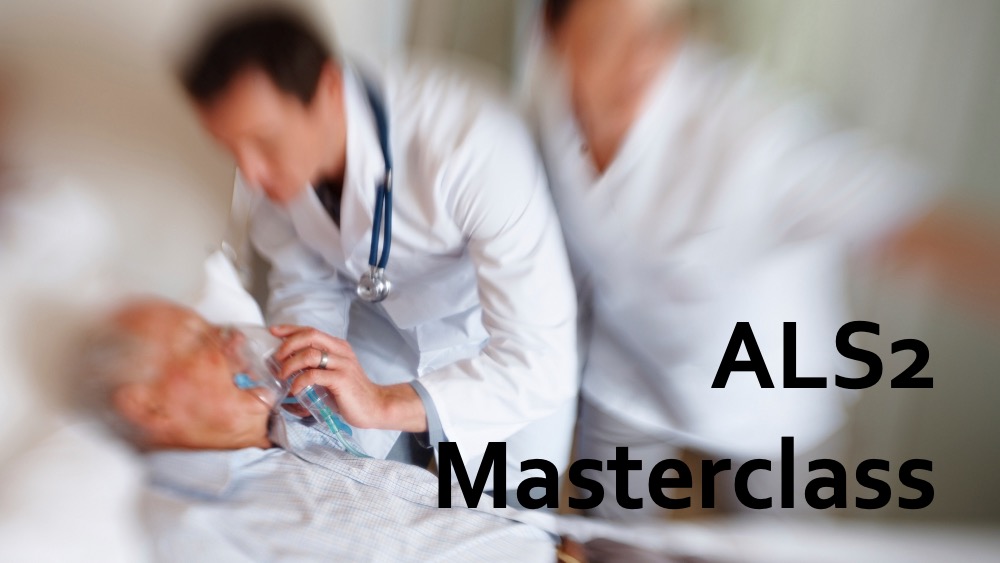 The ALS Masterclass course is designed for medical and nursing staff to be (re)accredited in the skills required for Basic and Advanced Life Support with a focus on extending the knowledge and skills in Resuscitation/Stabilisation of the critically Ill or arrested patient.
The course is delivered in a supportive learning environment and uses interactive online pre-learning to cover core knowledge skills and a one day workshop for procedural skills and simulation training.
The course is suited to health professionals who wish to extend their knowledge in management of the seriously ill or deteriorating patient in the emergency setting, met call, and rural and remote environment.
Topics covered in the course include include:
-
Basic and Advanced Life Support
-
CPR during Covid19 and in special circumstances
-
Assessment and Resuscitation of the Critically Ill Patient
-
Basic Airway Management
-
Acute Respiratory Distress and Non-invasive Ventilation
-
Circulatory Shock and Sepsis
-
Cardiac Arrhythmias: ECG Diagnosis, Cardiac Pacing, Cardioversion
The ALS Masterclass course is a blended program. This means that some of the learning is done online (eLearning) and some undertaken face to face in a workshop setting.
Please note access is restricted to those registered for ALS2 Masterclass
Facilitator Certificate (Aug 2025)

Facilitator Certificate: Clinical Education and Training
Structured Online Learning in Preparation for the Workshop
About the Course
The course has been developed to provide a foundation to the delivery of clinical education and training.
The course explores The Educator/Facilitator role, Program Development, Leading Interactive Small Group Discussions, Teaching Procedural Skills, Immersive Simulation Training, Assessment, Competency and Evaluation and Challenges to Clinical Education.
The Course has three components:
-
Course Work undertaken over 12 weeks
-
Face to Face training delivered over two days and
-
Work Based Assessments.
Certification will require satisfactory completion of all three components and satisfactory completion of the Work Based Assessments assessing competency in the areas of Procedural Skills Training, Clinical Simulation and Group Discussion.
Course Learning Outcomes
At the completion of the course the learner should be able to
-
Apply teaching behaviours and attitudes that incorporate adult learning principles and promote learner centred clinical teaching.
-
Prepare and deliver white board presentations that demonstrate structure, relevance and the engagement of learners.
-
Research, structure and teach procedural skills that considers the environment, time constraints, learners needs and background, equipment and assessment of learning.
-
Prepare and manage clinical simulation scenarios that are realistic, appropriate to the learner's level of skill/knowledge, take account of learner safety and recognise the critical role of debrief in maximising learning and reflection.
-
Structure the teaching of bedside clinical skills that takes into the welfare of the patient, consent and learner safety, and demonstrates the strategic use of questions to prompt learning and provide guided feedback to the learner.
-
Become self-reflective educators that actively seek to continue to learn, develop their skills and draw on observer feedback to continually develop their teaching practice.
Newborn Advanced Life Support 2025

B-CET: CRASH + NALS Workshop
Critical Care - Resuscitation - Advanced Life Support - Newborn ALS
Welcome to the B-CET CRASH + NALS eLearning
The course is delivered using a combination of online learning of core material with a hand's on skills / simulation workshop. The course covers a broad range of resuscitation skills and knowledge required for the management of the critically ill patient and resuscitation of the newborn.
Course Learning Objectives
At the completion of the CRASH course, participants will be able to demonstrate competency in the application of critical thinking and procedural skills to :
1. Structured assessment of the critically ill or deteriorating patient
2. Recognition and emergency management of immediate life threats to the airway, breathing, circulation and central nervous system
3. Basic and Advanced Life Support in the patient in cardiac arrest
4. Participation and clinical leadership of the resuscitation team
5. Initiate of resuscitation of the newborn
CRASH - Paediatrics Prelearning 2022/23
CRASH Paediatrics - Prelearning
Assessment and Management of the Critically Ill or Injured Child
Managing the seriously ill child can be one of the most frightening and distressing experiences for the clinician. There are many challenges to assessing and treating the child presenting with serious illness, including recognising the early signs of serious illness, lack of a detailed history and examination, issues relating to patient cooperation, procedural difficulties (eg. obtaining IV access) and physiological challenges (eg. masking of signs of severe illness and risk for rapid deterioration). In this course we explore the immediate assessment and treatment of the seriously ill child and examine the clinical presentation and acute management of 4 life threatening diseases in children.
The prelearning explores the following 9 topics:
1. Paediatric Basic and Advanced Life Support
2. Red Flags for Serious Illness
3. Resuscitation ABCDs in the Seriously Ill Child
4. Airway: Acute Anaphylaxis
5. Breathing: Acute Respiratory Distress
6. Circulation: Paediatric Vomiting and Dehydration
7. Disability: The Fitting Child
8. Exposure: Neonatal Sepsis
9. Newborn Resuscitation
Course Accreditation
ACRRM
-
Accredited CPD Course : 2020- 2022
-
Advanced Life Support
- 12 Performance review, 6 Educational activity, 1+12 MOPS point
RACGP
-
Accredited CPD activity : 2020- 2022
-
40 Accredited CPD Points
CRASH 2025 - Skills / Simulation Workshop

CRASH Critical Care
Critical Care ~ Resuscitation ~ Advanced Life Support
CRASH - Critical Care eLearning (2025)
The CRASH workshop was developed by a team of emergency physicians, rural GPs, and nurse and paramedic educators.
The program provides 24 hours of training incorporating online (eLearning) and a 2 day practical skills workshop. Topics include: Resuscitation of the Critically Ill/Injured Patient, Cardiopulmonary Resuscitation, Basic and Advanced Airway Management, Ventilation using an Oxylog Ventilator, Resuscitation Team Leadership and Teamwork, Difficult Vascular Access, Cervical Spine Management in Trauma, Chest Tube Insertion, Needle Aspiration, Cardiac Pacing/Cardioversion, and Newborn Resuscitation.
The workshop pre- and post-learning is delivered online and includes:
-
Basic Life Support (BLS)
-
Advanced Cardiac Life Support (ALS)
-
Approach to the Critically Ill Patient
-
Recognising and Managing the Obstructed Airway
-
Mechanical Ventilation: Use of the Oxylog Ventilator
-
Managing the Patient with Acute Respiratory Compromise/Ventilation
-
Non-Invasive Ventilation in Acute Care
-
Assessment and Management of Circulatory Shock
-
Assessing and Treating the Critically Ill Child/Newborn Resuscitation
-
Immediate Management of the Patient with Major Trauma
Please note: Access to the online course is restricted to participants registered for the CRASH Workshop
Information about the course
-
Designed for ED medical and nursing staff, Rural Medical Practitioners and Training Medical Officers
-
CME hours: Certified for 24 hours of continuing medical education
-
CPD accreditation: RACGP, ACRRM
-
Procedural Grant: Meets requirements for the Procedural Grant in Emergency Medicine and Anaesthesia
-
CPD Certificate is provided with successful completion of the course
Course Accreditation
The course is an accredited learning activity for medical continuing professional development. The course is an accredited CPD activity for : 2023-2025 triennium. RACGP (13.5 Educational Activity & 18 Reviewing Performance Points) and ACRRM (Points to be advised).
BCET CRASH - NALS 2025

B-CET: CRASH + NALS Workshop
Critical Care - Resuscitation - Advanced Life Support - Newborn ALS
Welcome to the B-CET CRASH + NALS eLearning
The course is delivered using a combination of online learning of core material with a hand's on skills / simulation workshop. The course covers a broad range of resuscitation skills and knowledge required for the management of the critically ill patient and resuscitation of the newborn.
Course Learning Objectives
At the completion of the CRASH course, participants will be able to demonstrate competency in the application of critical thinking and procedural skills to :
1. Structured assessment of the critically ill or deteriorating patient
2. Recognition and emergency management of immediate life threats to the airway, breathing, circulation and central nervous system
3. Basic and Advanced Life Support in the patient in cardiac arrest
4. Participation and clinical leadership of the resuscitation team
5. Initiate of resuscitation of the newborn
CRASH 2024 - Skills / Simulation Workshop
CRASH - Critical Care eLearning
The CRASH workshop was developed by a team of emergency physicians, rural GPs, and nurse and paramedic educators.
The program provides 24 hours of training incorporating online (eLearning) and a 2 day practical skills workshop. Topics include: Resuscitation of the Critically Ill/Injured Patient, Cardiopulmonary Resuscitation, Basic and Advanced Airway Management, Ventilation using an Oxylog Ventilator, Resuscitation Team Leadership and Teamwork, Difficult Vascular Access, Cervical Spine Management in Trauma, Chest Tube Insertion, Needle Aspiration, Cardiac Pacing/Cardioversion, and Newborn Resuscitation.
The workshop pre- and post-learning is delivered online and includes:
-
Basic Life Support (BLS)
-
Advanced Cardiac Life Support (ALS)
-
Approach to the Critically Ill Patient
-
Recognising and Managing the Obstructed Airway
-
Mechanical Ventilation: Use of the Oxylog Ventilator
-
Managing the Patient with Acute Respiratory Compromise/Ventilation
-
Non-Invasive Ventilation in Acute Care
-
Assessment and Management of Circulatory Shock
-
Assessing and Treating the Critically Ill Child/Newborn Resuscitation
-
Immediate Management of the Patient with Major Trauma
Please note: Access to the online course is restricted to participants registered for the CRASH Workshop
Information about the course
-
Designed for ED medical and nursing staff, Rural Medical Practitioners and Training Medical Officers
-
CME hours: Certified for 24 hours of continuing medical education
-
CPD accreditation: RACGP, ACRRM
-
Procedural Grant: Meets requirements for the Procedural Grant in Emergency Medicine and Anaesthesia
-
CPD Certificate is provided with successful completion of the course
Course Accreditation
The course is an accredited learning activity for medical continuing professional development. The course is an accredited CPD activity for : 2023-2025 triennium. RACGP (13.5 Educational Activity & 18 Reviewing Performance Points) and ACRRM (Points to be advised).
Pre-learning: Critically Ill Child Workshop 2025

Prelearning: Critically Ill Child Workshop 2025
Paediatric Emergencies: Assessment and Acute Management
Introduction
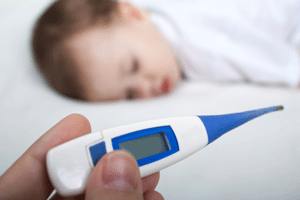
It is easy to miss the seriously ill child who presents with subtle clinical findings or to feel uncomfortable when required to manage the seriously ill child. At the workshop we will explore the signs of paediatric serious illness and the emergency management of the child fever/sepsis, surgical emergency, severe dehydration/shock, status epilepticus, trauma and severe respiratory distress.
The eLearning modules for the Critically Ill Child Workshop introduce many of the important principles relating to recognising and treating the seriously ill child, and provide the foundation for the clinical scenarios discussed in the workshop.
The modules are designed to be completed prior to attending the workshop. You should allow 60 - 90 mins to complete each of the modules.
The prelearning explores the following topics:
1. Red Flags for Serious Illness
2. Approach to the Seriously Ill Child
3. Acute Respiratory Distress and Life Threatening Asthma
4. Paediatric Vomiting and Dehydration
Pre-learning: Critically Ill Child Workshop 2024
Pre-Learning: Critically Ill Child Workshop
The young child with acute illness presents major challenges to the clinician: the history may be incomplete, the examination limited, and the clinical features of serious disease overlooked. In this topic, we consider the approach to the critically ill child and explore the clues on history and examination that indicate a risk for serious disease.
Prelearning: ECG Interpretation Workshop

Prelearning: ECG Interpretation
A clinically based approach to ECG Interpretation
Prelearning for ECG Interpretation: Core Skills and Advanced ECG
A case based workshop for Medical officers, Nurses, Paramedics and Students
Learning to read and confidently interpret an ECG is a valuable skill for assessing and treating patients with a wide range of acute presentations including chest pain, syncope, stroke and shortness of breath. In this course we introduce an easy to learn approach to ECG interpretation that allows the clinician to quickly identify clinically significant findings such as acute myocardial ischaemia, arrhythmias, conduction block and serious biochemical disorder. The approach is highly practical and can be immediately applied to the clinical care of the emergency patient.
The prelearning explores the following topics:
-
1. Introduction to a clinically based approach to ECG Interpretation
-
2. Some really basic ECG physiology
-
3. Why the P wave is often the clue to arrhythmias
-
4. How the QRS is useful to clinical practice
-
5. ECG diagnosis of Cardiac Arrhythmias
-
6. How to avoid missing the ECG clues to myocardial ischaemia
The workshop is delivered over two days and you may attend Day 1 or Day 2 or both days - your choice !
Day One: Core ECG Skills
Day One includes the following topic areas
-
Basic ECG physiology
-
Structured approach to ECG interpretation
-
Introduction to Conduction disorders : AV Block, Bundle Branch Block, Wolf Parkinson White
-
Introduction to Myocardial Ischaemia: ECG changes of ST Elevated Myocardial Infarction
-
Recognising basic rhythm disturbances: Atrial fibrillation, Supraventroicyuklar Tachycardia, Ventricular Tachycardia.
Day one is recommended for those new or inexperienced in ECG interpretation or wanting to review Core ECG skills.
Day Two: Advanced ECG Interpretation
Day Two includes the following topic areas
-
Mycocardial Ischaemia: Posterior STEMI, Right Ventricular STEMI, Non-STEMI, new patterns of ischaemia (Wellen, de Winter, LMCA and Proximal LAD stenosis
-
Acute Pericarditis, Benign Early Repolarisation
-
Advanced conduction abnormalities (Bifasicular block, Brugada)
-
Biochemical and toxicological disorders
-
Complex arrhythmias.
Day two assumes basic ECG knowledge of Bundle branch block, STEMI and common arrhythmias (AF, SVT and VT).
Facilitator Certificate (May 2025)

Facilitator Certificate: Clinical Education and Training
Structured Online Learning in Preparation for the Workshop
About the Course
The course has been developed to provide a foundation to the delivery of clinical education and training.
The course explores The Educator/Facilitator role, Program Development, Leading Interactive Small Group Discussions, Teaching Procedural Skills, Immersive Simulation Training, Assessment, Competency and Evaluation and Challenges to Clinical Education.
The Course has three components:
-
Course Work undertaken over 12 weeks
-
Face to Face training delivered over two days and
-
Work Based Assessments.
Certification will require satisfactory completion of all three components and satisfactory completion of the Work Based Assessments assessing competency in the areas of Procedural Skills Training, Clinical Simulation and Group Discussion.
Course Learning Outcomes
At the completion of the course the learner should be able to
-
Apply teaching behaviours and attitudes that incorporate adult learning principles and promote learner centred clinical teaching.
-
Prepare and deliver white board presentations that demonstrate structure, relevance and the engagement of learners.
-
Research, structure and teach procedural skills that considers the environment, time constraints, learners needs and background, equipment and assessment of learning.
-
Prepare and manage clinical simulation scenarios that are realistic, appropriate to the learner's level of skill/knowledge, take account of learner safety and recognise the critical role of debrief in maximising learning and reflection.
-
Become self-reflective educators that actively seek to continue to learn, develop their skills and draw on observer feedback to continually develop their teaching practice.
Facilitator Certificate (August 2024)

Facilitator Certificate: Clinical Education and Training
Structured Online Learning in Preparation for the Workshop
About the Course
The course has been developed to provide a foundation to the delivery of clinical education and training.
The course explores The Educator/Facilitator role, Program Development, Leading Interactive Small Group Discussions, Teaching Procedural Skills, Immersive Simulation Training, Assessment, Competency and Evaluation and Challenges to Clinical Education.
The Course has three components:
-
Course Work undertaken over 12 weeks
-
Face to Face training delivered over two days and
-
Work Based Assessments.
Certification will require satisfactory completion of all three components and satisfactory completion of the Work Based Assessments assessing competency in the areas of Procedural Skills Training, Clinical Simulation and Group Discussion.
Course Learning Outcomes
At the completion of the course the learner should be able to
-
Apply teaching behaviours and attitudes that incorporate adult learning principles and promote learner centred clinical teaching.
-
Prepare and deliver white board presentations that demonstrate structure, relevance and the engagement of learners.
-
Research, structure and teach procedural skills that considers the environment, time constraints, learners needs and background, equipment and assessment of learning.
-
Prepare and manage clinical simulation scenarios that are realistic, appropriate to the learner's level of skill/knowledge, take account of learner safety and recognise the critical role of debrief in maximising learning and reflection.
-
Become self-reflective educators that actively seek to continue to learn, develop their skills and draw on observer feedback to continually develop their teaching practice.
Emergency Nursing Assessment
Pre-learning: Triage Workshops July 2019
The following pre-learning assists participants to prepare for the Triage workshop focusing on the nursing assessment of the emergency patient.
BHF - Procedural Sedation and Analgesia
BHF - Procedural Sedation and Analgesia
This course explores the following topics :
-
1. Parenteral Procedural Sedation : Core Principles
-
2. Intravenous Sedation using Midazolam / Fentanyl
-
3. Intravenous Sedation using Propofol
-
4. Parenteral Sedation using Ketamine
-
5. Intranasal Sedation using Midazolam, Fentanyl, Ketamine
Please note this course has been developed for the upskilling of medical and nursing staff working in the Barossa-Hills Fleurieu Local Health Network in SA. If you do not work in this region but are interested in completing a course in an accredited course in Procedural Sedation and Analgesia you may enrole in the recently updated LearnEM CPD course by clicking the course link below :
View Procedural Sedation and Analgesia
BHFLHN : Procedural Sedation and Analgesia
BHFLHN : Procedural Sedation and Analgesia
Please Note : This course is designed for Clinical Staff working the Barossa Hills Fleurieu Local Health Network.
Procedural sedation describes the administration of drugs in a controlled setting to reduce pain and/or awareness. In the emergency department it is used for a wide variety of procedures, including laceration repair, reduction and immobilisation of fractures or dislocations, incision and drainage procedures, wound exploration and removal of foreign bodies from the eye, ear, nose and skin. Procedural sedation is most often used in healthy adults and children (>3 months) and those with mild well-controlled systemic disease (eg. asthma).
The sedative agents most commonly used for procedural sedation are Midazolam +/- Fentanyl, Propofol, Ketamine and Ketofol. This course examines the indications, contraindications for procedural sedation, assessment, monitoring and after care of the patient undergoing procedural sedation and examine in detail the common drugs used for procedural sedation.
This course explores the following topics :
-
1. Parenteral Procedural Sedation : Core Principles
-
2. Intravenous Sedation using Midazolam / Fentanyl
-
3. Intravenous Sedation using Propofol
-
4. Parenteral Sedation using Ketamine
-
5. Intranasal Sedation using Midazolam, Fentanyl, Ketamine
-
6. Intravenous Regional Anaesthesia - Bier Block (Optional)
If you have any problems or require more information: Contact LearnEM Support
Mt Barker - Dislocations / Plastering
Mt Barker : Emergency Orthopaedics
Clinical/Radiological Assessment, Upper Limb Injury, Joint Dislocation, Plaster Splinting
Acute orthopaedic injury is a common emergency presentation and occurs across all age groups with injuries ranging from minor through to limb or even life threatening. In this prelearning we explore the assessment of orthopaedic injury, management of upper limb injuries, the diagnosis and treatment of joint dislocation, and application of plaster splinting.
The course is open to those enrolled in the EDCARE GP training evening.
Obstetric Essentials Prelearning 2019
Obstetric Essentials : Prelearning
Latest Course update: January 2019
Obstetrics Essentials is designed for GPs, TMOs, Nurses, and Midwives to update knowledge in Obstetric Emergencies and Newborn Resuscitation. The course is also suited to nurses and students wanting to gain knowledge and confidence with deliveries. The course is delivered in a supportive learning environment, using interactive online pre-learning to cover core knowledge skills and a one day workshop for procedural skills and simulation training.
Topics covered in the program include include:
-
Emergencies in Early Pregnancy
-
ED Assessment and Management of Pre-Eclampsia/Eclampsia
-
Assessment and Management PV Bleeding in Late Pregnancy
-
Managing Delivery in the Emergency Department
-
Managing the Patient with Postpartum Haemorrhage
-
Neonatal Resuscitation
Information/Registration
Register for Obstetrics Essentials
Course Cost: $495 (inc GST) – Registration includes access to Course eLearning and One Day Skills and Simulation workshop.
Course Venue: LearnEM Training Centre, 47 Manton Street, Hindmarsh, SA 5007
Course accreditation: Australian College of Nursing, Australian College for Rural and Remote Medicine, Royal Australian College of General Practitioners.
The program qualifies for a two day procedural grant in Obstetrics. The course meets minimum competency requirements for clinical privileging for the SA Department of Health.
Further information
Contact: Nikki Crichton, LearnEM Program Coordinator
-
Phone: (08) 7226 8225
-
Email: nikki@learnem.com.au
Emergency Plaster Splinting and Fracture Management (2025)
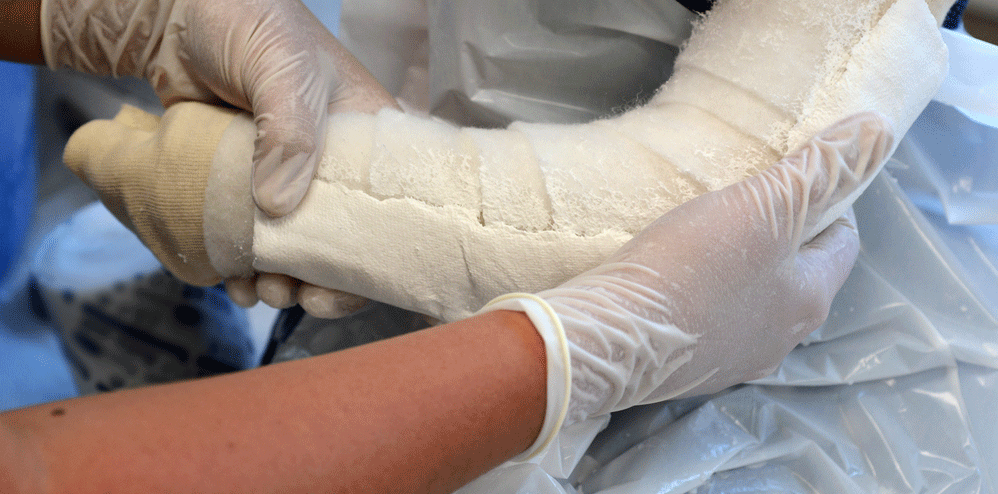
Emergency Plaster Splinting and Fracture Management
Orthopaedic Splinting and Fracture Management: Principles, Procedure and Techniques
Plaster Splinting and Fracture Management for Emergency Practice
Plaster Splinting is central to much of fracture management and requires a set of skills to ensure a plaster that is correctly applied and avoids the risk of causing further injury.
While the practical skills for plaster casting and splinting will be covered in the workshop, there are an important set of core principles that can easily be described and provide a solid foundation to the use of plaster casting/splinting in clinical practice.These are discussed in a series of short video eTutorials.
Additional resources have been included that may be used to extend learning - these include videos that demonstrate a range of plaster casts, short readings that explore the range of orthopaedic injury and links to LearnEM online courses that focus on orthopaedic injury.
Emergency Plaster Splinting and Fracture Management
Emergency Plaster Splinting and Fracture Management
Orthopaedic Splinting and Fracture Management: Principles, Procedure and Techniques
Plaster Splinting and Fracture Management for Emergency Practice
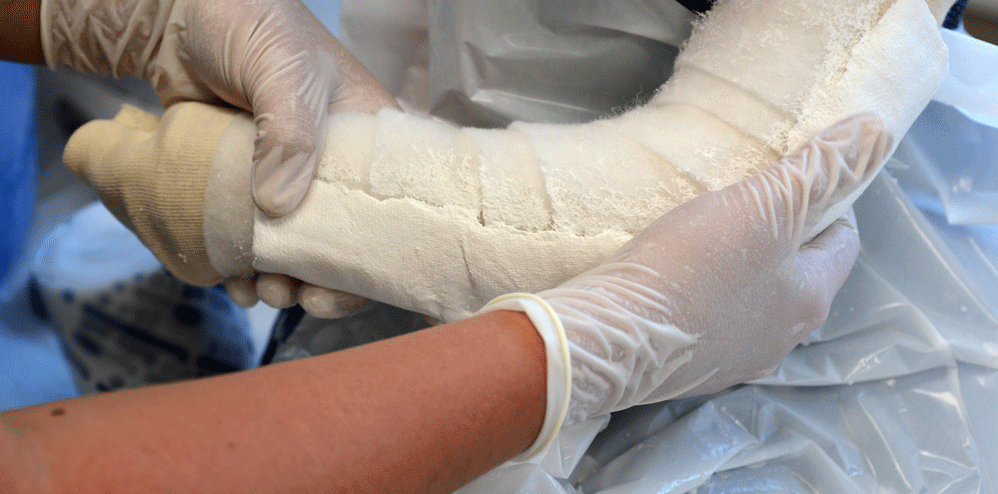
Plaster Splinting is central to much of fracture management and requires a set of skills to ensure a plaster that is correctly applied and avoids the risk of causing further injury.
While the practical skills for plaster casting and splinting will be covered in the workshop, there are an important set of core principles that can easily be described and provide a solid foundation to the use of plaster casting/splinting in clinical practice.These are discussed in a series of short video eTutorials.
Additional resources have been included that may be used to extend learning - these include videos that demonstrate a range of plaster casts, short readings that explore the range of orthopaedic injury and links to LearnEM online courses that focus on orthopaedic injury.
Emergency Wound Management (2025)
Emergency Wound Management
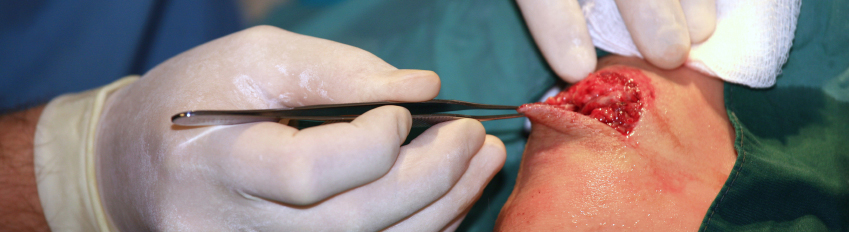
Assessment, Debridement and Closure of Simple Wounds
Introduction
Latest Update: January 2024
Although simple wounds are common in acute care it is always important to begin assessment with a primary survey with the aim of exclude immediate life threats (such as severe shock). The history and examination should identify any concomitant injury(s) or disease, risk factors that may complicate wound management and assess the wound for injuries to vital tissues such as tendons, nerves and joints. The aim is to identify those wounds requiring referral due to nerve, tendon vascular, joint injury or with extensive tissue loss from the simple wounds that can using be debrided and easily closed.
In this topic we will spend some time discussing wound assessment as this needs to be undertaken carefully to avoid missing injuries to vital structures such as tendons and nerves or retained foreign bodies, which if unrecognised may be associated with significant complications and /or long term morbidity or disability. At the completion of this topic you should be confident to assess a wound for serious injury and within your scope of practice be able to debride and manage the majority of the wounds you encounter in your clinical practice.
Peter Stuart and the LearnEM Team